Resources



Chronic absenteeism, defined as missing 10% or more of school days, is often seen as an early warning indicator, suggesting a likely risk of academic challenges. But what if this threshold is actually too late?
Dr. Tiffany Wu, researcher at the University of Michigan, recently joined us for a live session to share her research exploring when exactly academic risk can emerge. If you missed it, read on for the highlights, or join our K-12 Attendance Network to watch the recording.
Since the pandemic, chronic absenteeism has roughly doubled, climbing from 14% to nearly 28% nationwide. With more students than ever at risk, the "sensitivity" of our early warning signals matters more than ever.
Dr. Wu’s research, in partnership with Boston Public Schools and the Massachusetts Department of Elementary and Secondary Education, challenged the core assumption that 10% is the point where a student’s academic risk fundamentally changes.
Dr. Wu and her colleagues analyzed state test scores coming out of Boston Public Schools, considering how much a student’s absenteeism would predict whether or not they would meet academic expectations on these exams. She acknowledged that sometimes, you can guess incorrectly, either assuming a poor performance when there wasn’t one, or expecting results than reality. The goal in the research, and of course, in real life, is to identify the students who truly need support, while avoiding unnecessary work and intervention. In other words, Dr. Wu set out to find the amount of absences that correctly indicated where academic risk emerged.
Here’s what she found:
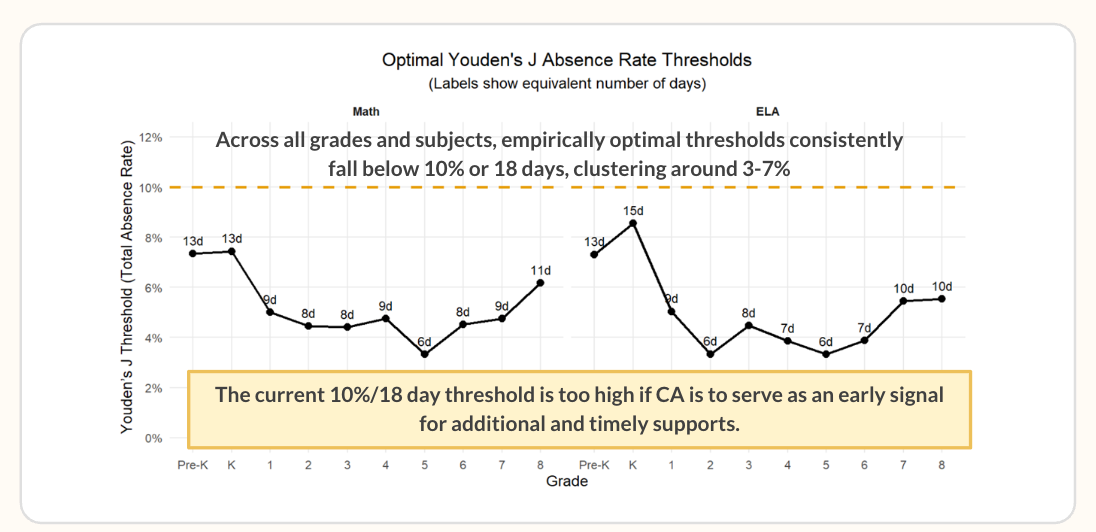
Dr. Wu is not suggesting that we launch intensive, high-cost interventions the second a student misses their fifth day of school. There are life’s realities of illness or family challenges, and perfect attendance should never be the goal. However, the research underscores how essential every day of learning is to student success.
Every day truly matters. If we want to move the needle on student outcomes, we have to shift our thinking to more universal supports and early intervention, instead of waiting for 10% to cue action. By shifting our focus to earlier warning signs, we can provide the right support at the right time, and get more students back on track for success.